
Let’s read:
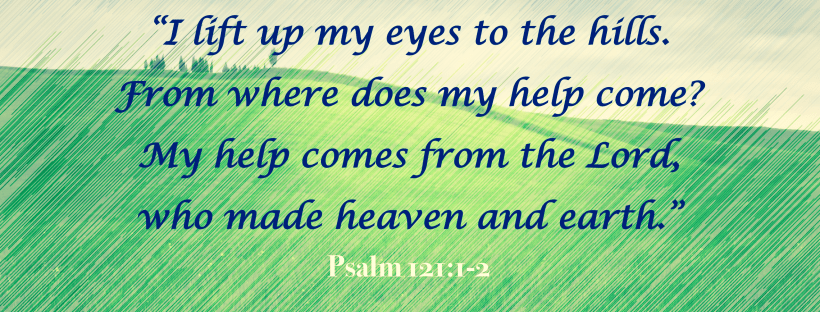
“I lift up my eyes to the hills.
From where does my help come?
My help comes from the Lord,
who made heaven and earth.”
[Psalm 121:1-2]
This affirmation is beautiful.
But how many of us truly believe that our help comes from God?
How many of us remember that God is actually there to help us?
How many of us accept His help when He sends it?
I ask these questions in the hope that we would each search ourselves for our personal response and then adapt our ways and just stop cheating ourselves of God’s gracious mercy.
1 – How many of us truly believe that our help comes from God?
“It just happened…”
“I got lucky…”
“By coincidence…”
Can I tell you that God knows every single thing about you – from the tiniest strand of hair on your head, to the soles of your feet, to the dinner you ate, and the time you brushed your teeth – God knows everything!
Therefore nothing that happens to you is simply by coincidence, or ‘just happens’.
If you have a look at the bible, it tells us that God has already written every single thing concerning us, way before we even took our first breath, or first step;
“…all the days ordained for me were written in your book
before one of them came to be.”
[Psalm 139:16]
(Also read the whole of Psalm 139)
God who made you, is always looking out for you and this is something the bible reminds us of more than once – (Deuteronomy 31:6, Hebrews 13:5).
So please friend, rather than attributing things to chance, just take a moment to reflect a bit more, and begin to acknowledge the Grace, Mercy and Help of God in your life.
2 – How many of us remember that God is actually there to help us?
Trust me, I know…
I know how hard it can get, how cloudy it can get, how confusing it can be, how low you can reach at times, that even to look up no longer seems like an option.
But please, I encourage you to look up! And remember that you know a Living God who works miracles – He’s done many things before, and He’ll surely do much more.
“I will remember the deeds of the Lord;
yes, I will remember your miracles of long ago.
I will consider all your works
and meditate on all your mighty deeds.”
[Psalm 77:11-12]
(Read all of Psalm 77 when you get a chance)
No matter how bad it may seem, you have to remember that there is nothing impossible for the Omnipotent (All-Powerful) God.
“Ah, Sovereign Lord, you have made the heavens and the earth by your great power and outstretched arm. Nothing is too hard for you.”
[Jeremiah 32:17]
And I haven’t missed out those of us who forget God simply because we’re too busy trying to figure things out logically, or practically – please be reminded that Wisdom and Power are His – Daniel 2:19-20, Proverbs 3:19-20 – God knows exactly what to do and how to do it! (And His way will definitely be better than ours).
3 – How many of us accept His help when He sends it?
Now this refusal of God’s help can be down to many things; pride, lack of clarity that it’s actually from Him, denial that you need help at all (acting like it’s all okay), trying to do things ‘practically’ (as mentioned above), or simply because we believe we don’t need it/Him.
Whatever our reasoning may be, I want us to rethink our decision and have a read of the various verses above that not only prove how ‘qualified’ God is to help us, but they actually show us how worthy God is of honour and praise! (And I don’t mean to belittle God by calling Him qualified, because He is Almighty, but I hope you get what I mean).
We should realise that we are truly privileged that He cares enough to always come when we cry (Psalm 46:1).
I want to remind you that we mustn’t be foolish to think that we can do it all alone, or that we don’t need God, for the bible tells us to,
“Trust in the Lord with all your heart,
and do not lean on your own understanding.”
[Proverbs 3:5]
Finally, I want to encourage you to go back and read the whole of Psalm 121 (I know, quite a lot of reading in this one) and in case this part skipped your eye, I want you to notice that verse 2 says ‘the Lord who made heaven and earth’, pointing out the fact that His ability to help you is Limitless.
This should tell you then, that He is simply the best place to run to; no-one above Him, no-one better than Him, and most importantly, no-one who knows you like He does!
So here’s a task,
“My help comes from the Lord” – say it out loud to yourself over and over again, and make sure that it sticks so strongly in your mind, that you don’t for one second again, try to do this problem-solving thing (or anything!) without Him.
Keep the Faith, Don’t Stop Believing
God Bless you.

 Untainted Word